Ingredient literacy
You read every label. Then you get to the cleaning aisle.
A field guide to reading a cleaning label: what the panel leaves out, the word that hides the most, and what a full list looks like.
You built the habit somewhere else. Probably food first, then skincare, then the baby aisle, until turning a package around before it goes in the cart stopped feeling like effort and started feeling like the minimum. You know what to skip. You know which words are marketing and which are chemistry.
Then you push the cart into the cleaning aisle and the habit stops working.
Not because the labels are hostile. Because on a lot of them, there is very little to read. A bright front panel, a set of promises, a warning box, and then a back panel that lists a handful of things in a language that manages to be both technical and vague. You can read the whole bottle in nine seconds and come away with almost nothing you can act on.
It turns out one of the companies advertising to label readers this month is unusually blunt about why.
Part oneThe company running the ad says the quiet part in its own course
Branch Basics sells a cleaning concentrate. It also gives away a video course, taught by its founders, about clearing household products out of a home. One of the lessons is about cleaning products specifically, and the description on the company's own page does not hedge:
Cleaning products are unregulated in the United States and many contain harmful, toxic chemicals that are undermining our health. Branch Basics, lesson 06 of the Toss the Toxins course
Take that at face value or don't. What matters for a label reader is the structural claim underneath it, and you can verify that part yourself in about a minute: the panel on a cleaning bottle is simply not built to answer the question you are asking it.
The same course spends a whole lesson on the reading problem. Lesson 04 is called Vetting Ingredients on Labels, and the company describes it this way: "Reading product labels and ingredient lists can be daunting, but there are great free tools online that can simplify the process." A brand that had nothing to gain from an informed shopper would not build a lesson around teaching one.
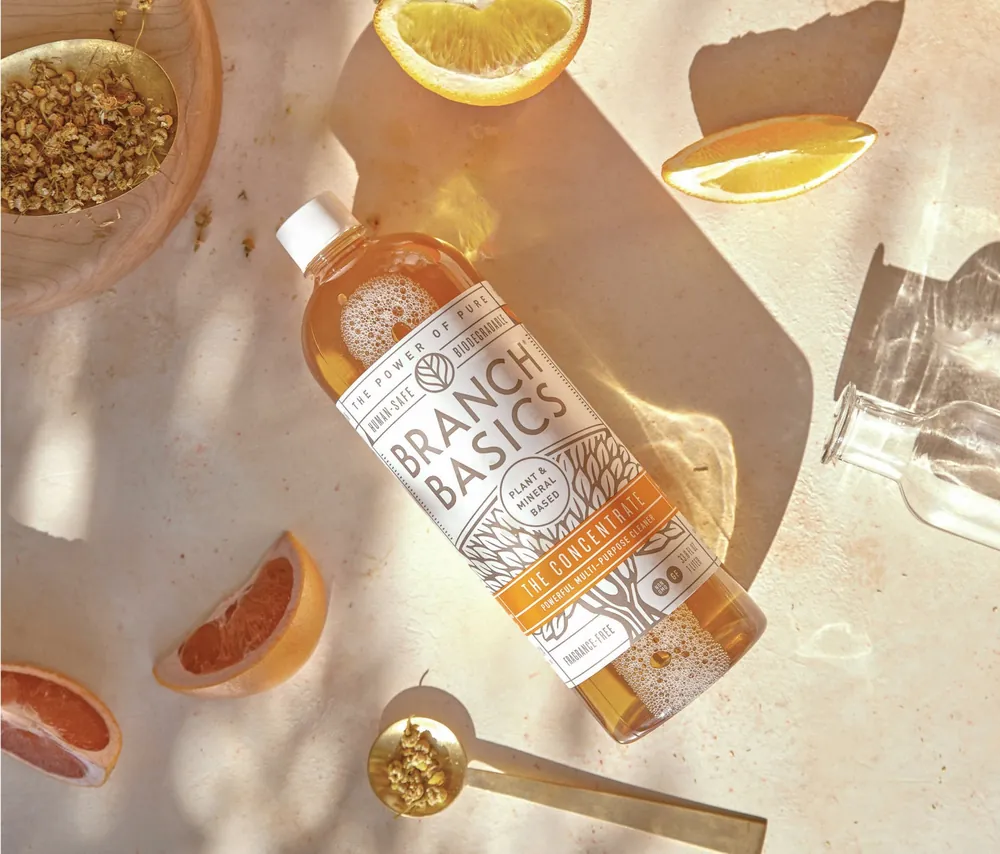
Three questions that break most cleaning labels
Skip the front of the bottle entirely. It is written to be believed, not read. Turn it over and put the back panel through three questions, in this order. They take longer to describe than to run.
1. How many ingredients are actually named?
Not categories. Names. A category is a bucket that can hold anything the manufacturer decides to put in it; a name is a commitment. Count the named ones and hold that number against the seven at the top of this page. If a product does more jobs than a concentrate that names seven ingredients, and discloses fewer, that gap is information.
2. Does anything on the list tell you what it is for?
This is the question almost no label survives. A list of names is a start. A list of names where each one is paired with its job is a different document: it means somebody inside the company was willing to be pinned to a reason for every line. It also means you can evaluate the formula rather than just accept it. Look at the panel above again and notice that four of the seven come with a stated purpose.
Anatomy of an entry that answers question 2
3. Is there a word doing the work of a paragraph?
Certain words on a back panel are not ingredients at all. They are containers. Fragrance is the famous one, and again Branch Basics devotes an entire lesson to it, promising to explain "what fragrance really is, all the places it is hiding in your home." The brand's own summary of its formulation standard is three phrases long: "no fragrances, no harsh chemicals, no compromises."
Whatever you think of the brand, that is the right test to carry down the aisle. Named, explained, and nothing standing in for a list.
A fair caveat before you go further. Everything below is drawn from what Branch Basics publishes about itself: its product page, its ingredient page and its course. Those are marketing documents. The reason they are worth reading anyway is that they are unusually specific, and specific claims are the only kind you can check.
The receipt: they publish registry numbers
Here is the part that separates a company willing to be checked from a company that would rather be trusted.
Branch Basics keeps a public ingredients page for its powdered products. It does not just list what is in them. It lists what each ingredient does, and next to that it prints the registry number that identifies the substance, so you can go and look it up somewhere the company has no control over.
This is the full disclosure for their laundry detergent, a fifteen gram dose:
| Ingredient | Registry no. |
|---|---|
| Sodium CarbonateRemoves dirt and grease | 497-19-8 |
| Sodium PercarbonateBleach, stains | 15630-89-4 |
| Sodium GluconateAnti-redeposition, water softener | 527-07-01 |
| Sodium Lauryl SulfoacetateSurfactant | 1847-58-1 |
| Sodium MetasilicatepH regulator | 6834-92-0 |
| TAEDBleach activator | 10543-57-4 |
| Decyl GlucosideFoamer, cleaner | 68515-73-1 |
| Poly (itaconic acid-co-AMPS) Sodium SaltPolymer, softener | 1052620-22-0 |
| ProteaseBreaks down stains | 9014-01-1 |
| AmylaseBreaks down starch | 9000-90-2 |
Read that table as a label reader and notice what it costs the company. Sodium Percarbonate is a bleaching agent and they say so. Sodium Lauryl Sulfoacetate is a surfactant with a name close enough to one people avoid that plenty of brands would have buried it. It is on the list, in position four, with its number.
Publishing a registry number is a small act with a large implication. It is an invitation to go around the brand and check.
Opens branchbasics.com. Every ingredient, every function, every registry number.
What the seven ingredients are supposed to replace
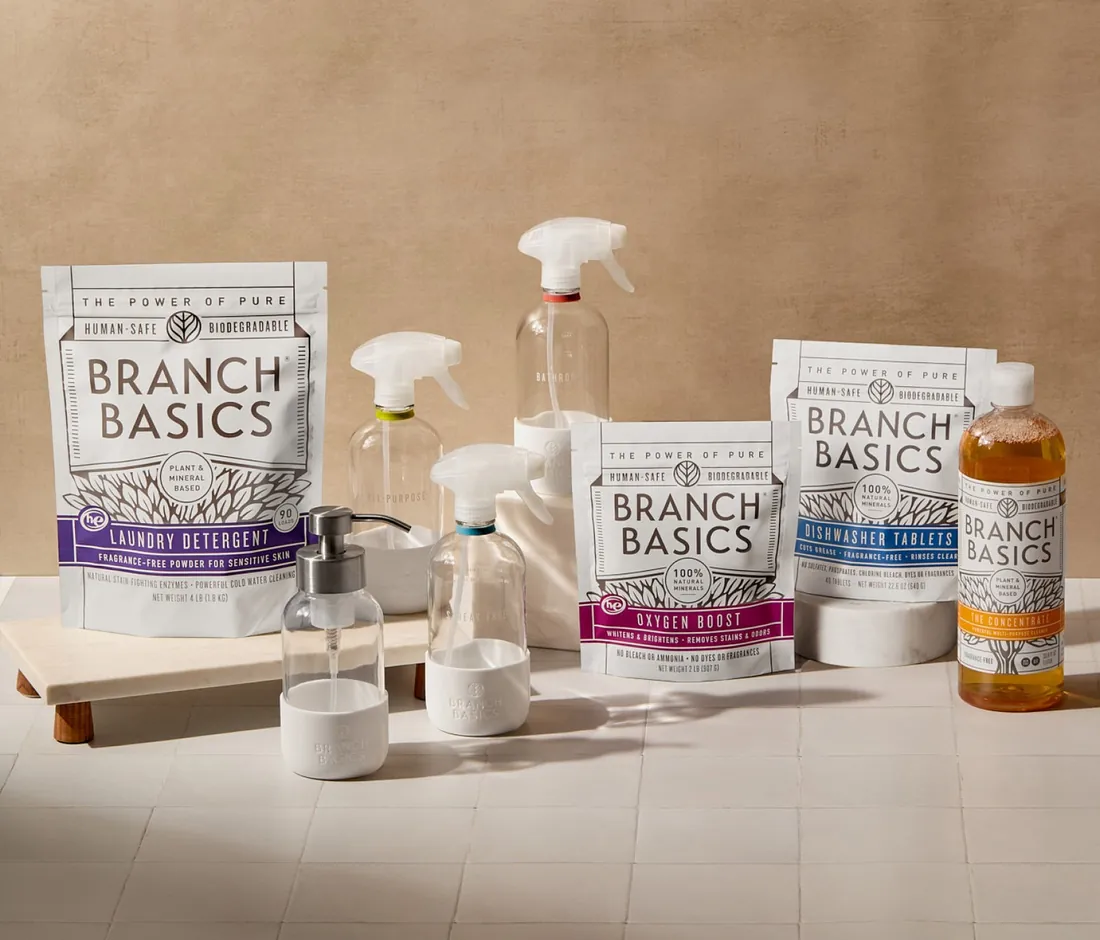
The Concentrate is a 33.8 fl oz bottle that the company describes as replacing all cleaning supplies once diluted with water. That is a large claim, and the mechanism is deliberately unglamorous: you are buying the cleaning agents without the water, and adding the water at home.
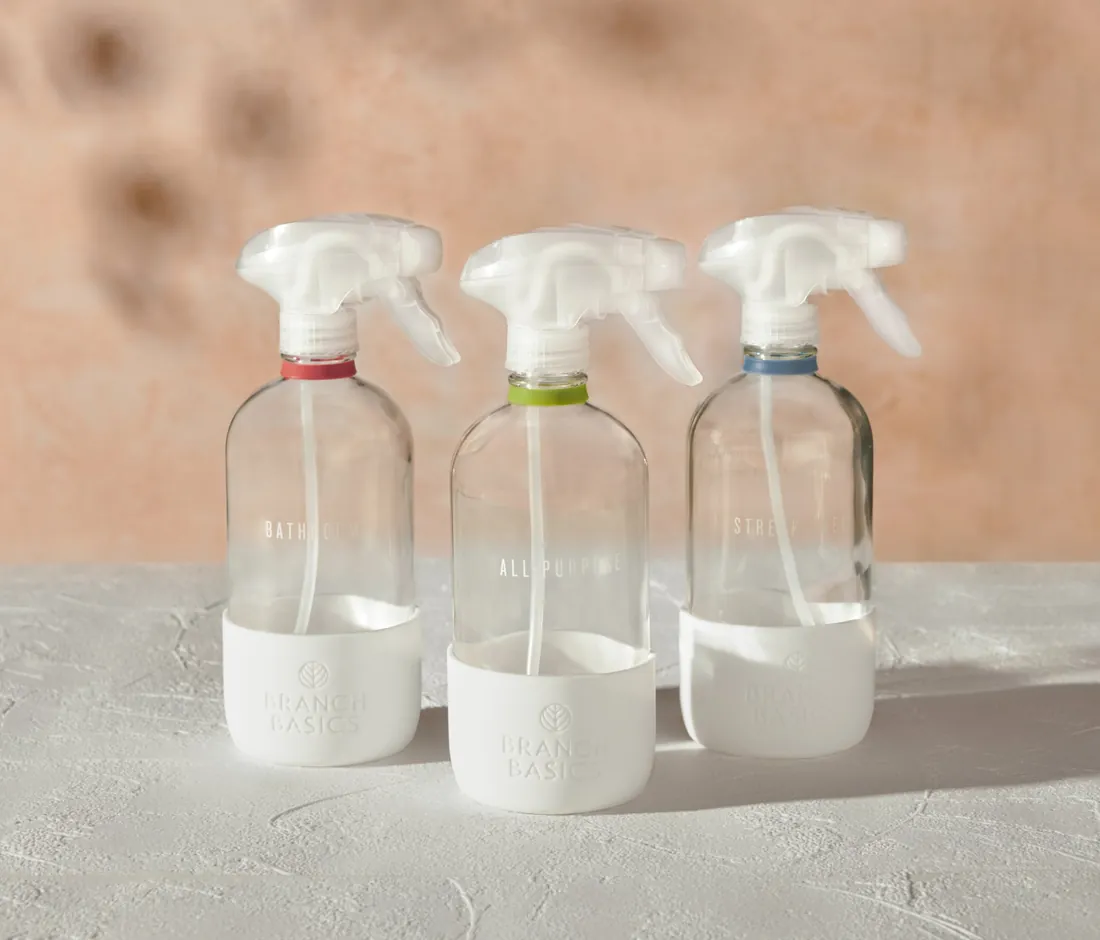
Every refillable bottle in the range carries different fill lines, which is what lets one liquid become a different cleaner in each one. The all-purpose bottle gets a weak dilution. The bathroom bottle gets a stronger one. The streak-free bottle gets barely any at all, which is why a reviewer below sounds surprised that it works.
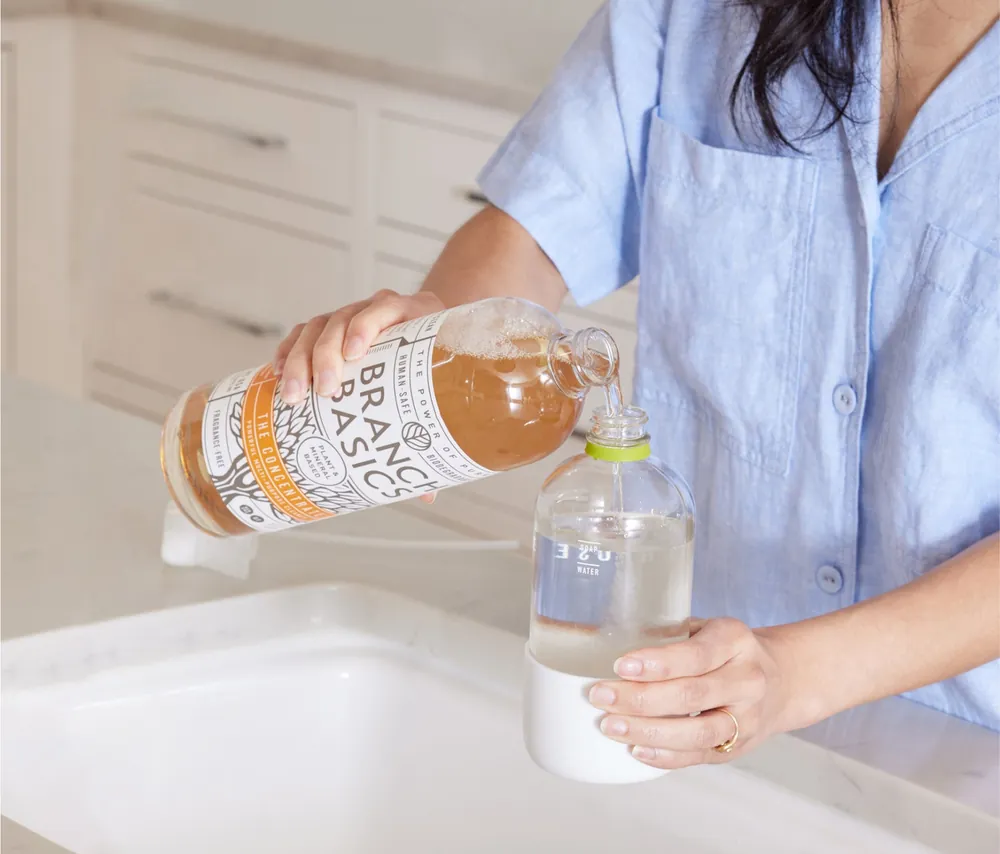
Branch Basics publishes what one bottle turns into, with a price on each line. This is their arithmetic, not ours:
The number that does the most work there is the streak-free one. Forty-nine cents for a bottle of glass cleaner is the kind of figure that only makes sense once you accept that most of what you have been carrying home from the store, and paying to ship, is water.
The list of what is not in it, and one thing they refuse to claim
The company publishes a short exclusion list for the Concentrate. As with any exclusion list, it tells you as much about what the category normally contains as it does about this product:
- Sulfates
- Chlorine
- Phosphates
- Phthalates
- Parabens
- Endocrine disruptors
More interesting is the thing they decline to claim. Somewhere in the FAQ on the product page, where almost nobody scrolls, is a paragraph that a marketing department would normally fight to delete:
Branch Basics is not a disinfectant, sanitizer or antibacterial soap. Sanitizers and disinfectants work to kill germs while leaving them in place, which can actually kill good bacteria and create resistant superbugs when certain germs don't die. Instead, Branch Basics removes germs vs. killing them. Branch Basics, FAQ on the Concentrate product page
They go on to say that sanitizing is only rarely necessary, and note that the CDC recommends plain soap and water to remove germs in a home. But the sentence that counts is the first one. In a category built on kill claims, this company put the words "is not a disinfectant" on its own page, in bold, above the fold of the FAQ.
For a label reader, a refused claim is worth more than three earned ones. It is the only part of a marketing page that costs the company something to write.
Two more things a careful reader will want
The colour is inconsistent, and they explain it
Bottles arrive anywhere from pale straw to deep amber. A batch-to-batch colour shift in a household product is usually the sort of thing a company hopes you will not notice. Branch Basics answers it directly in the FAQ: the chamomile extract varies by crop and darkens over time, so the colour ranges from very pale to deep amber and all of it is normal.
That answer is only available to a company that has one variable ingredient instead of a standardised industrial base. It is a consequence of the seven-line list, not a defect in it.
The pH is published
8.5, plus or minus 0.5, stated in the technical section of the FAQ. Mildly alkaline, which is consistent with a grease-cutting cleaner and with a formula the company describes as gentle enough to use on skin. Very few cleaning products publish a pH at all, because very few expect to be asked.
Part sevenWhat nearly six thousand buyers actually say
The Concentrate carries a public review score on the company's own store. The distribution matters more than the average, so here is the whole shape of it:
Four reviews, quoted exactly as published, chosen because they answer the questions a sceptic would ask rather than because they are the warmest:
★★★★★
At first we didn't believe 1 concentrate could do as many different types of cleaning as this one says it can…we had 1 week with this product and are convinced we've found the best product available!
Ray R. · verified buyer · May 21, 2026
★★★★★
The product is amazingly good. Hard to believe the streak free glass cleansers with so little concentrate but it does and doesn't leave any residue on the glass
Deborah M. · verified buyer · August 8, 2026
★★★★★
I like it! Price seems high but it's very concentrated and last a long time.
Danielle P. · verified buyer · June 8, 2026
★★★★★
Love this product! Lasts us a couple of years and is strong enough to get through any stains and clean up the mess. I have 2 babies and a dog and have put this product to the test with a variety of messes.
Marie S. · verified buyer · July 16, 2026
The third one is the useful review. Fifty-five dollars for one bottle reads as expensive next to a four dollar spray, and it stays expensive right up until you put it next to the thirteen refills it is supposed to produce. Whether that trade is worth it is a judgement about your own household, not a fact anyone can hand you.
Take the three questions with you, whatever you buy
You can walk out of this article without buying anything and still be better armed in the aisle. The three questions further up work on any bottle, in any brand, in any store, and they cost you about forty seconds.
What makes Branch Basics worth the detour is not that it passes those three tests. It is that it published enough to be tested at all: the whole list, the functions, the registry numbers, the pH, the batch variation, and a paragraph explaining what the product cannot do. That is a company betting that the more carefully you read, the better it looks.
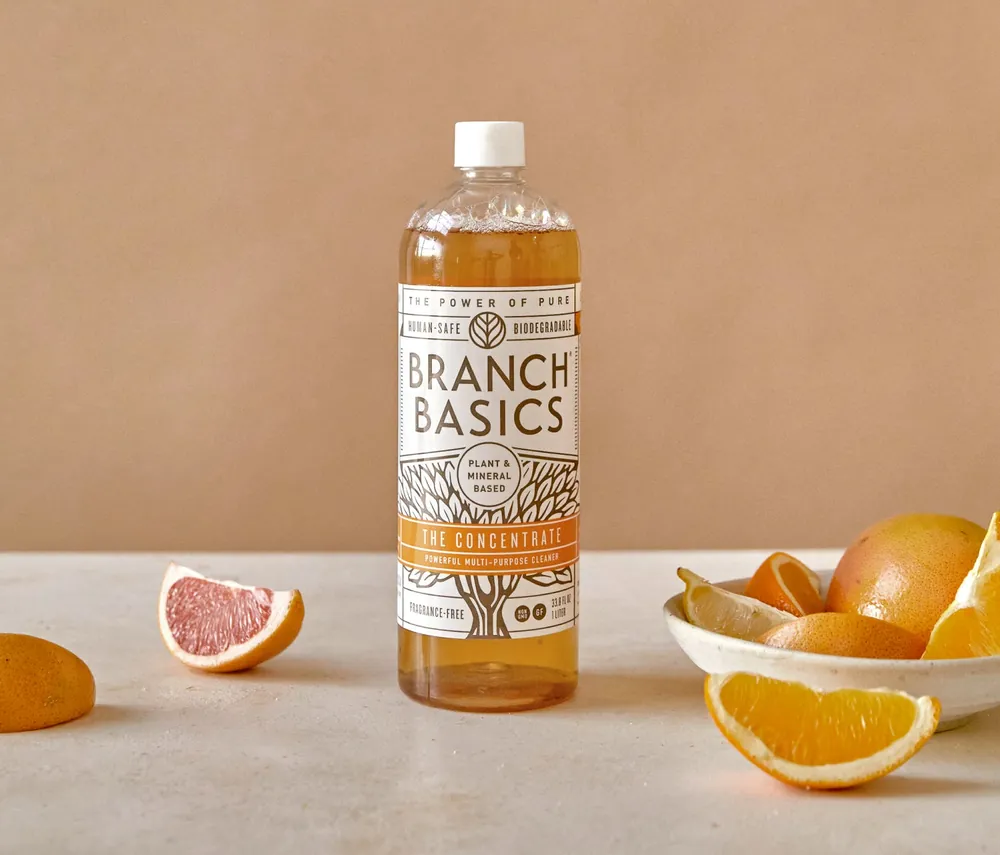
The Concentrate is $55 for a one-time purchase, or $49.50 on a subscription that can be changed, skipped or cancelled at any time. Shipping is free over $35 in the contiguous US, and there is a 60 day money-back guarantee.
33.8 fl oz · $55 one-time or $49.50 on subscription · 60 day money-back guarantee